Over a period of less than 24 hours on Wednesday, 24 June three significant (magnitude > 5) earthquake events around the world highlighted how important the specific intersection of hazard, exposure and vulnerability are in defining the consequences of catastrophe events.
At 18.04 local time, a magnitude 7.5 earthquake struck northern Venezuela, approximately 100 miles west of the capital, Caracas. The USGS PAGER first look modelled estimates suggest that over 10 million people experienced strong shaking (MMI > VI), with damages likely to exceed USD 10bn and potentially thousands of fatalities. So far, official reports from Venezuela are limited, but images show severe widespread damages and fatality reports are likely to rise over the coming days.
Earthquakes are relatively common in Venezuela, a right-lateral strike-slip fault runs along the northern coast of the country, known as the Oca-Ancón fault, west of ~67°W, and the El Pilar fault, east of ~67°W, where a third right lateral strike-slip fault runs to the southwest. The M7.5 event occurred on the juncture of these faults, likely on the main east-west fault. The M7.5 is reported by the USGS as the mainshock of a doublet, being preceded just 39 seconds earlier by a M7.2 event, extending the duration of shaking experienced on the ground.
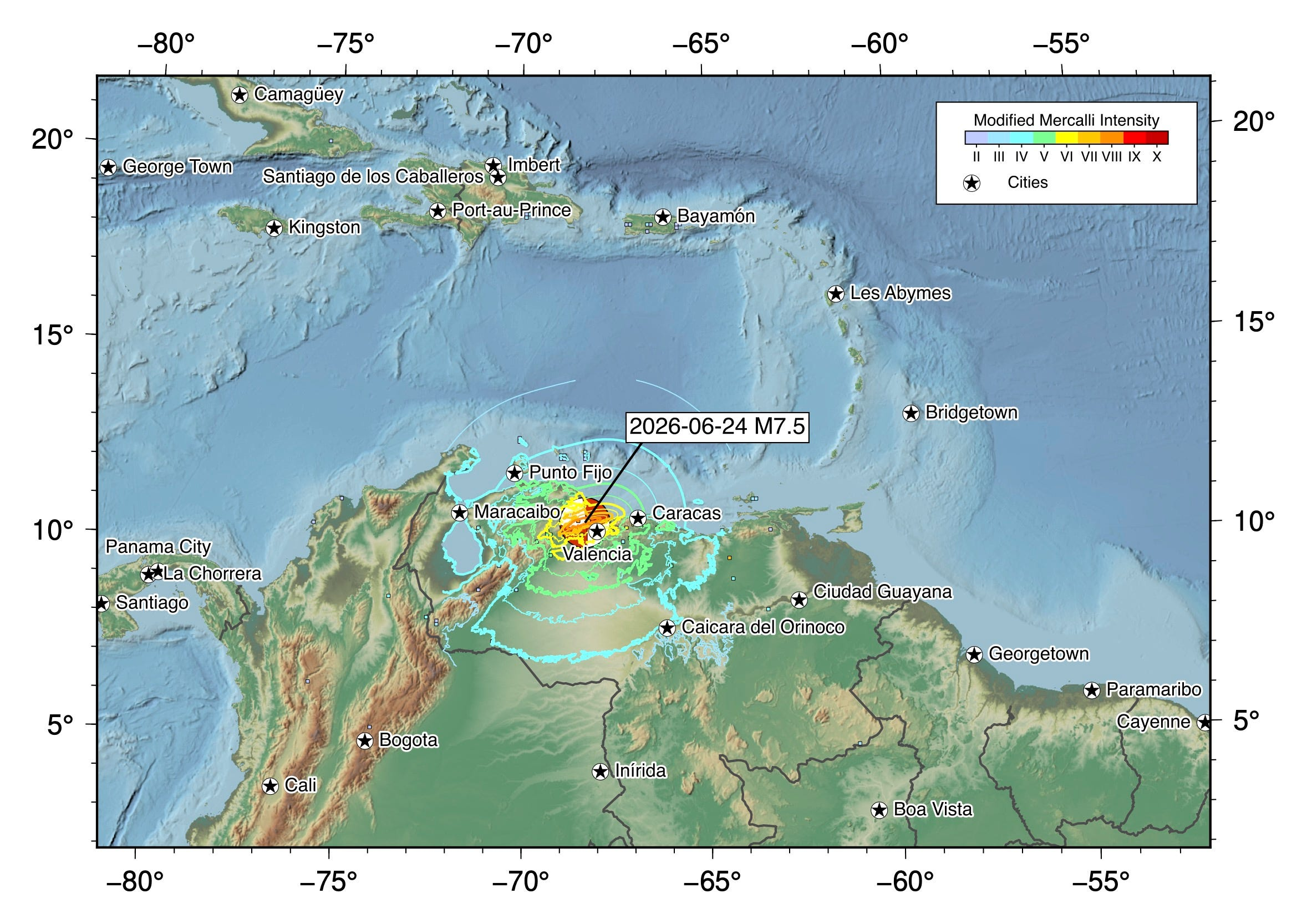
Source: USGS, Earthquake Insights, J.A. Hubbard and K. Bradley. As at 25 June 2026.
26 minutes after the Venezuela event a magnitude 6.9 earthquake struck offshore of the east coast of Japan 30km east-northeast of Kuji in the Iwate prefecture. A magnitude 6.9 in this region of Japan is not unusual. A magnitude 7.6 earthquake occurred close by in December 2025 and the more significant events in 2021 (M7.1) and 2022 (M.3) both occurred in similar regions further south along the Tohoku northeast coast region of Japan. The USGS PAGER estimate 345,000 people experienced strong shaking, although damages are expected to be minimal.
Earlier in the day at 8.10am local time a magnitude 5.6 earthquake struck 7 miles north of Redwood Valley, inland Mendocino County, Northern California, approximately 120 miles north of San Francisco. The region impacted is lightly populated, with USGS PAGER estimating 21,000 people experienced strong shaking (MMI > VI). Impacts appear relatively limited with no reports of serious injury or significant structural damage.
Based on current market information and preliminary industry loss estimates, we do not anticipate insured losses from the Japan and California events to reach levels that would be financially material for our cat bond portfolio. With regard to the Venezuela event, while the earthquake itself is significant, our cat bond portfolio has no exposure to the region and we therefore do not expect an impact from this event. We do not expect any material impact on our mixed ILS portfolios from these events.
As always, Twelve Securis continues to closely monitor any catastrophe events and will issue specific updates on any relevant new major events which occur.
For professional or qualified investors only. This material is provided for informational purposes only and does not constitute investment advice or a solicitation or offer to buy or sell any financial instrument.
Twelve Securis regularly publishes investment updates as well as thought leadership pieces related to the asset classes it manages.
Find Out More
Twelve Securis can help you navigate the world of insurance investing.
Contact Us